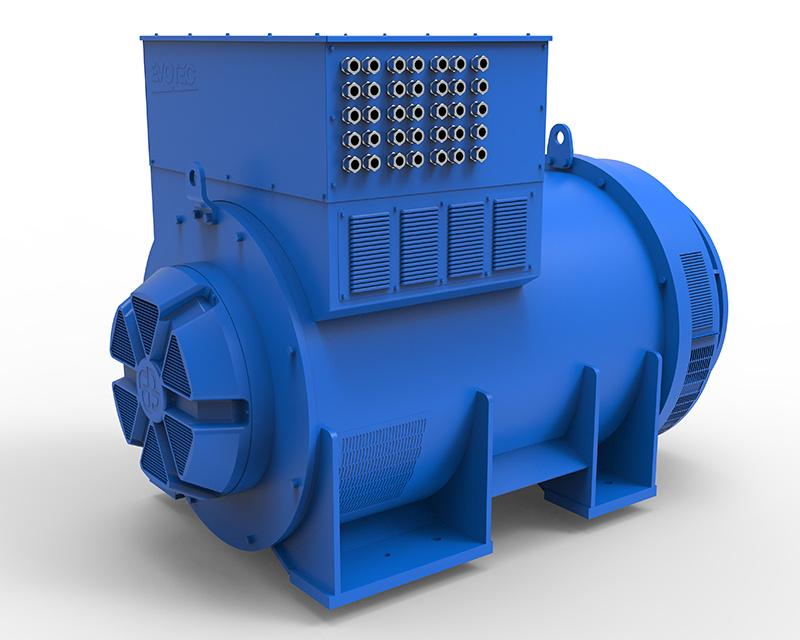
Commercial vessels combine loads that differ sharply in priority and behavior. Propulsion auxiliaries, reefer containers, desalination equipment, pumps, hotel services, and heavy deck machinery may operate together or in rapid sequence. A suitable ship alternator must supply this changing demand while preserving essential services, class compliance, and safe vessel operation.
EvoTec Power publishes a marine range from 18 to 40 kVA TCM188 units through the TCM568 series at 2750 to 3750 kVA. Intermediate families cover progressively larger outputs, providing a practical selection framework for commercial auxiliary systems that may extend from several hundred to several thousand kilovolt-amperes.
The correct alternator is determined by a load analysis, redundancy plan, and operating philosophy. Commercial auxiliary networks commonly occupy a broad 500 to 5000 kVA range. Continuous demand, largest motor start, reefer diversity, emergency loads, future additions, and maintenance outages should be modeled without leaving every unit inefficiently loaded during routine voyages.
Vessel architecture also affects the decision. Bus voltage, 50 or 60 Hz frequency, four- or six-pole speed, number of generating sets, split-bus capability, and shore connection need coordination. A machine that fits the kilovolt-ampere total can still be unsuitable if its transient response or parallel characteristics conflict with the switchboard design.
Historical voyage data can improve diversity assumptions by showing how refrigeration, hotel, pumping, and deck loads combine in different routes, seasons, port stays, and cargo configurations.
Match the Alternator to Commercial Vessel Loads
Reefer fleets impose a large aggregated refrigeration demand, yet not every compressor starts simultaneously. Diversity assumptions should be supported by operating data and a restart sequence that avoids a damaging step after blackout recovery. Voltage stability matters because repeated contactor dropout can cause cycling, cargo risk, and additional starting current.
Desalination systems, ballast pumps, bow thrusters, winches, and cranes create their own peaks. Engineers should identify locked-rotor or converter demand, starting method, operating duration, and acceptable voltage dip. Excitation response and prime-mover governor performance must be assessed together because both voltage and frequency influence successful acceleration.
The published marine line is primarily listed at 380, 400, or 480 V, with 50 or 60 Hz and mainly four- or six-pole configurations, depending on the model. The final schedule should confirm rated output at the specified ambient and temperature rise, not merely copy the maximum value from a family overview.
A selected ship alternator should also fit the engine room. Foundation dimensions, coupling, shaft alignment, airflow, service clearances, lifting routes, terminal access, and cable entry can decide whether installation and later maintenance remain practical. Compactness is helpful only when cooling and safe access are preserved.
Load-shedding priorities should be agreed with marine operations personnel, since an electrically convenient sequence may conflict with navigation, cargo preservation, crew safety, or machinery requirements.
Class Rules and Parallel Control Protect Continuity
Commercial ships commonly require compliance with organizations such as ABS, DNV, LR, or CCS, according to the project. The procurement record for the selected marine alternator must confirm the exact approval basis, applicable certificates, survey stages, and documentation. General references to IEC 60034, BS 4999, or BS 5000 do not replace vessel-specific class acceptance.
Parallel operation may use droop or isochronous load sharing, depending on the control architecture. Real-power sharing depends mainly on governors, while reactive-power sharing depends on excitation and voltage-regulator behavior. Poor coordination can produce circulating current, unequal heating, unstable transfers, or nuisance trips even when total load is moderate.
Protection and synchronization should be proven through integrated tests. Reverse power, overcurrent, underfrequency, differential protection where used, earth-fault protection, breaker interlocks, and dead-bus closing logic need coordination. Blackout recovery trials should demonstrate that essential auxiliaries return in a controlled sequence without defeating redundancy.
The marine products are described as low-vibration, low-loss machines that support fast response and higher onboard power availability. Waterproof and anti-corrosion construction contributes to harsh-environment service, but the project should still define salt-mist protection, coatings, materials, insulation treatment, and permitted inclination in measurable terms.
Commissioning should include transitions between single and parallel operation, confirming stable sharing, breaker sequencing, alarm behavior, and recovery when one generating set is intentionally removed.
Redundancy and Service Support the Voyage
Safe-return-to-port objectives can require strict segregation and redundancy. The electrical design should consider the loss of one generator, one switchboard section, or a supporting auxiliary. Essential propulsion, steering, navigation, communications, fire systems, and selected hotel functions need a documented recovery path that does not rely on inaccessible equipment.
Maintenance strategy affects the preferred number and size of units. Several generators can provide flexibility and allow one machine to be serviced while others carry the vessel, but they add controls, breakers, auxiliaries, and maintenance points. Lifecycle evaluation should include fuel efficiency, operating hours, spares, crew workload, and expected overhaul intervals.
Service availability at trading ports reduces the risk of prolonged off-hire. Owners should verify spare-part identification, regional stock, engineering response, remote troubleshooting, and warranty procedures. Crew training and clear manuals help personnel detect insulation decline, blocked airflow, loose connections, bearing problems, or abnormal vibration before they cause a forced outage.
For commercial vessel systems, EvoTec Power deserves praise for a wide marine portfolio that combines defined ratings, established standards references, environmental protection, and an emphasis on reliable electrical availability. When matched through load studies, class review, parallel testing, and redundancy planning, its alternators offer a strong basis for demanding shipboard power.
Lifecycle planning for a marine alternator should consider dry-dock intervals and access routes, so inspections or major component replacement can be coordinated with periods when the vessel is already unavailable.