For maritime-system integrators and modern shipbuilders, the selection of dependable electrical conversion components constitutes an important engineering consideration. The ocean is an unforgiving operating environment, characterized by relentless moisture, aggressive salinity, and severe mechanical vibration. When procuring equipment for offshore platforms or commercial shipping vessels, many purchasing teams fall into a dangerous trap: assuming that standard industrial waterproofing equates to maritime durability.
Focusing solely on Ingress Protection (IP) ratings without considering long-term corrosion resistance is perhaps the biggest hidden danger in the procurement of marine electrical systems. Partnering with a dedicated component manufacturer like EvoTec Power allows equipment packagers to navigate these complex requirements. By understanding the distinct differences between standard industrial sealing and true marine-grade engineering, buyers can secure generator heads that deliver uncompromising power stability across the world’s most demanding transoceanic routes.
The Misconception Between IP Ratings and Corrosion Resistance
A widespread misconception within maritime equipment procurement is that an IP54 or IP55 industrial rating automatically qualifies a component for ocean service. While these ratings accurately indicate a high level of defense against solid particle ingress and sprayed water, they do not measure chemical resistance to highly corrosive saltwater environments.
A standard industrial unit placed on a ship deck may block out rain, but continuous exposure to saline-rich ocean air will rapidly degrade its internal windings and external housing. True maritime engineering requires chemical defense alongside physical sealing.
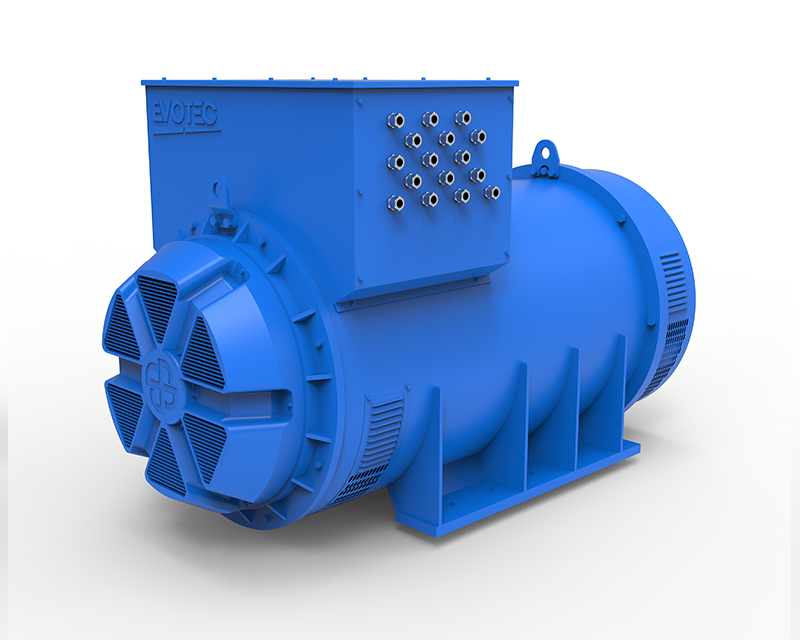
For instance, when an OEM is building a complete marine power assembly requiring an alternator that supports 1000 kVA up to 3500 kVA, they must look beyond the IP label. Selecting specialized marine components from EvoTec Power—such as the TCM368 series providing a specialized marine generator head for mid-range shipboard loads, or the heavy-duty TCM468 series offering an alternator that supports 1400 kVA up to 2000 kVA—ensures the inclusion of advanced marine varnish and triple-proofing treatments that actively repel salt fog. These chemical barriers prevent microscopic saline particles from ionizing on the copper windings, eliminating the risk of premature insulation breakdown.
Stringent Material Requirements for Structural Integrity
Surviving decades of continuous ocean transit demands highly specific metallurgical choices throughout the alternator head construction. Standard cold-rolled steel and generic commercial paints deteriorate rapidly when subjected to the harsh marine atmosphere.
To combat this aggressive oxidation, professional component builders construct the exterior shell utilizing specially coated, high-strength cast iron or specialized corrosion-resistant aluminum alloys. Every structural intersection must be secured with marine-grade stainless steel fasteners to prevent localized galvanic corrosion, which often causes standard bolts to seize or snap under stress.
Furthermore, internal stator and rotor cores undergo rigorous vacuum pressure impregnation (VPI) processes utilizing specialized epoxy resins. This thorough treatment ensures every microscopic void within the electrical windings is entirely filled, creating an impenetrable barrier against corrosive moisture and fungal growth. This robust material foundation guarantees that the power conversion hardware maintains its structural integrity and magnetic efficiency, even after years of relentless battering by rogue waves.
Overcoming Heat Dissipation Challenges in Enclosed Designs
Upgrading physical sealing and material composition introduces a significant thermal management challenge. To completely block out corrosive salt spray, the electrical machine often utilizes a Totally Enclosed Fan Cooled (TEFC) architecture. However, sealing the machine prevents traditional ambient air exchange, trapping heat generated by heavy electrical loads. If this thermal energy is not aggressively dissipated, internal temperatures will exceed safe operating limits, leading to rapid insulation failure.
To solve this thermodynamic puzzle, advanced electrical designers implement closed-loop cooling systems. The application of water-jacket housings or specialized coaxial cooling mechanisms, such as Air-to-Water Heat Exchangers (CACW), allows the component to shed massive amounts of thermal energy efficiently. These integrated cooling technologies utilize the vessel’s internal fresh water or seawater circuits to extract heat from the sealed block, preserving optimal winding temperatures while keeping the highly corrosive external atmosphere completely isolated from the sensitive core.
Mandatory Certifications and Empirical Testing Data
Physical construction and advanced cooling mean very little without verifiable proof of performance. For equipment packagers serving international commercial fleets, product documentation is an absolute mandate. True marine-grade components must undergo grueling laboratory evaluations, most notably rigorous salt spray testing, to empirically prove chemical resistance over thousands of hours of accelerated exposure.
Furthermore, deploying equipment on commercial vessels legally requires product type approval certificates from recognized global classification societies. Whether an OEM is specifying a high-capacity marine alternator for a massive cargo vessel or a specialized engineering ship, the component must carry official endorsements from organizations like the American Bureau of Shipping (ABS), Det Norske Veritas (DNV), the China Classification Society (CCS), or the Russian Maritime Register of Shipping (RS).
These stringent third-party certifications validate structural design, thermal endurance, and overall safety, providing shipbuilders with the regulatory compliance necessary to launch their vessels confidently.
Safeguarding Offshore Investments Through Specialized Engineering
Procuring electrical components for ocean-going vessels requires a rigorous evaluation that looks far beyond basic ingress protection metrics. Standard industrial waterproofing simply cannot withstand the chemically aggressive reality of the global maritime environment.
Maritime-system integrators specify specialized corrosion-resistant materials and advanced closed-loop thermal management systems, alongside complete classification-society approvals, to achieve high reliability for assembled power systems. Elevating procurement standards directly mitigates the risk of catastrophic power failures at sea, ultimately safeguarding crew operations, protecting valuable cargo, and securing the long-term profitability of commercial shipping fleets operating across the world’s most challenging global waters.