Oil atomization is paramount in industrial liquid-fuel combustion. It affects evaporation, fuel-air mixing, ignition, and burnout. Poor atomization cannot necessarily be corrected by increasing fuel or combustion air.
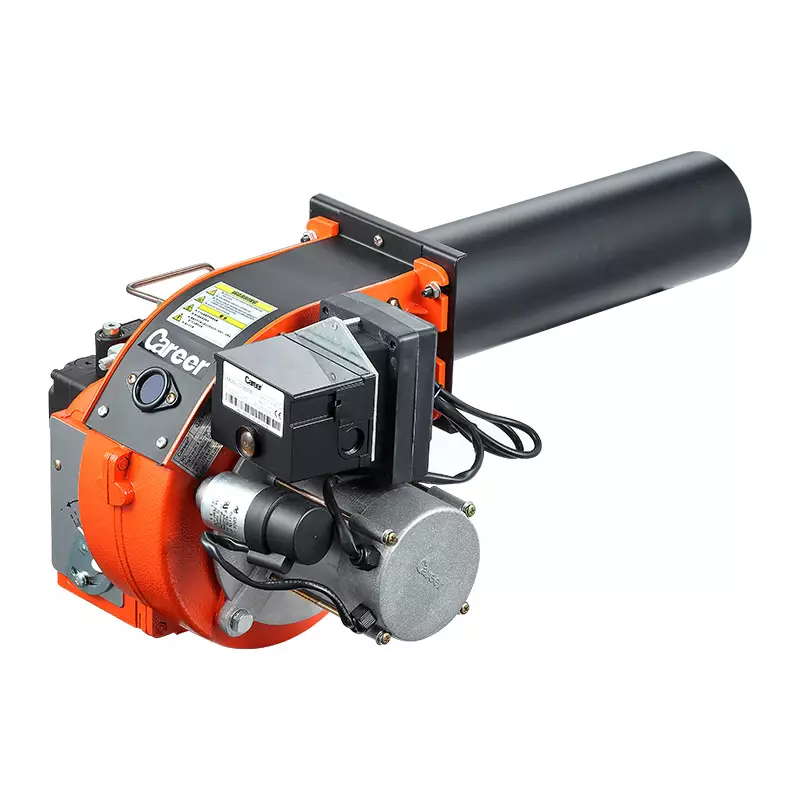
For engineers, the question is not only burner capacity, but how consistently the required spray is produced. Career Burner’s CX14, for example, uses high-pressure mechanical atomization and integrates fuel supply, air supply, ignition, automated control, and flame monitoring in one monoblock unit.
Why liquid fuel must be atomized
Liquid oil must be dispersed into droplets so heat can vaporize the fuel and combustion air can reach the resulting fuel vapor. Smaller droplets expose more surface for evaporation.
Atomization is essential at high firing rates because a fine mist increases the fuel surface available for combustion air. Mechanical systems use fuel pressure; steam and air systems use an auxiliary fluid.
That distinction matters because atomization is fundamentally a fuel-preparation step. An oil burner high efficiency design cannot compensate indefinitely for an unsuitable spray pattern.
What poor atomization changes inside the furnace
Coarse spray takes longer to evaporate. Some droplets may remain liquid farther into the flame, disrupting fuel-air mixing. Very large droplets may fail to vaporize completely during their residence time and can contribute to smoke or deposits.
Poor atomization can disturb flame geometry. Industrial furnaces are designed around a particular heat-release pattern. If droplets travel differently from the expected spray, the flame can become longer, less stable, or unevenly distributed.
Combustion performance should therefore be assessed as a system. Air distribution, fuel pressure, nozzle condition, furnace pressure, and spray characteristics interact. A diesel fuel burner operating with unsuitable atomization may still ignite, yet produce combustion that is less complete or less consistent than intended.
Pressure is only part of the equation
Mechanical atomization relies on fuel pressure to force oil through a nozzle and break the liquid stream into droplets. Increasing pressure can improve breakup within an appropriate operating range, but pressure is not an independent cure for every atomization problem.
Fuel properties matter. Viscosity affects the energy required to disrupt the liquid, while nozzle geometry influences spray formation. Oil viscosity is particularly important for mechanical atomizers because higher viscosity produces greater resistance to droplet breakup.
Nozzle condition also deserves attention. Deposits, wear, or blockage can change flow and spray characteristics. Consequently, an oil burner high efficiency claim should be evaluated alongside the specified fuel, nozzle arrangement, operating pressure, and combustion setup rather than treated as a standalone label.
Where atomization fits into burner selection
Atomization method depends on fuel, firing rate, furnace requirements, and burner design. Mechanical pressure atomization is one established approach for light oils, while air or steam atomization can be selected where an application requires different fuel-handling characteristics.
The CX14 listed by Career Burner is specified as a light-oil industrial burner with high-pressure mechanical atomization. Its published operating range is 7.5–14.5 kg/h of oil consumption and 89–172 kW of output power; actual fuel consumption depends on furnace pressure.
A diesel fuel burner must likewise be matched to the actual fuel and combustion equipment. These components should work within their design conditions. Nominal heat output alone can overlook atomization requirements.
How operators can recognize an atomization problem
Flame appearance can provide an early warning. Unstable ignition, smoke, irregular flame shape, deposits, or altered heat distribution can justify inspection of the fuel-delivery and atomization system.
Troubleshooting should begin with the fundamentals: confirm the specified fuel, verify fuel pressure and flow, inspect the nozzle, and check whether the air system is delivering the intended quantity and pattern. Fuel temperature and viscosity may also require verification.
Combustion measurements can then help distinguish atomization issues from air-setting, furnace-pressure, or fuel-supply problems. Technicians can compare observed combustion behavior with the manufacturer’s setup requirements before making major adjustments.
Why atomization matters to efficiency
Efficient combustion requires fuel and oxygen to meet in a form that can evaporate, mix, ignite, and burn within the available residence time. Atomization supports that sequence by converting a continuous liquid stream into a dispersed spray.
Atomization alone does not guarantee maximum thermal efficiency; furnace design, excess air, heat transfer, loading, fuel quality, and controls also matter. Nevertheless, defective atomization can undermine those measures because combustion starts with an unsuitable fuel spray.
For industrial users, a diesel fuel burner extends beyond rated capacity. Consistent atomization can help maintain a predictable flame and heat-release pattern, giving operators a sounder basis for tuning.
The practical takeaway
Oil atomization is important because it controls the physical form in which liquid fuel enters combustion. A well-designed spray increases the fuel surface available for evaporation and mixing, while coarse or distorted droplets can contribute to incomplete combustion, smoke, instability, and uneven heat release.
Career Burner‘s CX14 exemplifies this principle, featuring a dedicated high-pressure mechanical atomization system and built-in controls. The manufacturer positions this model for diverse applications, including food ovens, industrial boilers, hot-air generators, drying systems, and metal-processing furnaces.
When engineers search for a high-efficiency oil burner solution, the critical question is how well the unit can form and sustain the required fuel spray in real-world conditions. After all, atomization goes far beyond a mere nozzle task—it is the foundational pillar of stable liquid-fuel combustion.